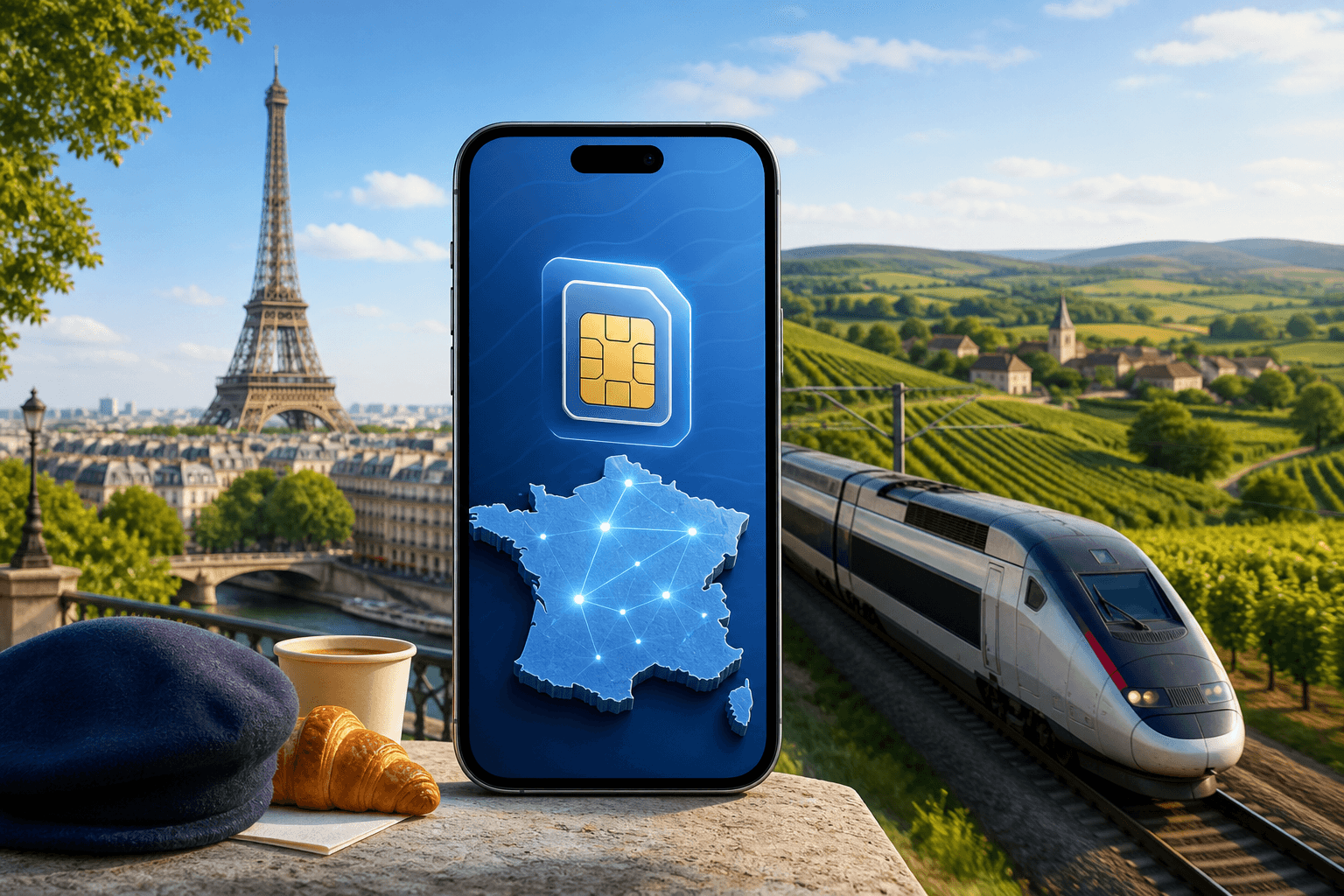
eSIM for France in 2026: plans, prices, and coverage in Paris, on the TGV, and in the countryside
A practical guide to choosing a France eSIM in 2026: plan sizes and prices, what coverage is like in Paris, on TGV routes, and in rural areas, plus setup steps and troubleshooting.
Published Oct 28, 20269 min read
In this guide
An eSIM is the easiest way to get mobile data in France without swapping your physical SIM: you add a second “travel data” line, keep your home number active for calls/texts, and use apps (WhatsApp, Telegram, FaceTime) over data.
If you want a ready-to-buy option, BeeSim sells data-only eSIM plans for France (and regional Europe bundles) with installation by QR code or one tap on iPhone: see the France eSIM page.
Which eSIM plan for France makes sense (sizes, validity, and prices)
France eSIM plans typically differ on three axes: how much data you get (GB), how long the plan stays valid (days), and whether it’s France-only or a multi-country Europe bundle.
Here are the France plan examples from the catalog (prices are charged in USD; sites often show an estimated local currency conversion):
- 3 GB / 30 days — see the current plan price
- 5 GB / 30 days — see the current plan price
- 10 GB / 30 days, see the current plan price
- 20 GB / 30 days, see the current plan price
- 1-day plan: 10 GB, see the current plan price
The full catalog range for France is:
- 7 fixed-data plans, plus daily plans
- Live prices on the plan page
- Fixed-data plans up to 50 GB, plus daily full-speed allowances
- 7, 30, or 180 days for fixed-data plans (plus a 1-day option listed above)
How to choose without overthinking it:
- A city week (Paris + day trips): a 30-day plan is usually the easiest fit because you don’t have to time activation to the hour. If you mostly use maps and messaging, with light browsing, start at 3–10 GB. If you’ll hotspot a laptop, upload lots of photos, or stream video, look at higher data tiers.
- A short stopover: the 1-day 10 GB option is built for “land, use a lot of data, leave.” It’s also useful if you need a high-data day for work and don’t want a longer plan.
- A longer stay or repeat visits: pick a plan with 180 days validity if you want coverage across multiple trips, or you’ll be in France for an extended period.
One operational detail that matters: with BeeSim, the plan’s days start counting when the eSIM first connects in France, not when you buy it. That means you can buy and install it at home on Wi‑Fi, then it “starts” when you land and it finds a French network.
France-only vs Europe regional eSIM: what to buy if you’ll cross borders
If your itinerary stays inside France, a France-only plan is straightforward.
If you’ll take trains or drives into neighboring countries, a Europe regional plan can be simpler than juggling multiple country eSIMs. France is in the EU, so a Europe plan works in France and can also cover you across the border in Belgium and Spain.
BeeSim also offers regional bundles labeled:
- Europe (31 areas)
- Europe (33 areas)
- Europe (30+ areas)
- Europe (40+ areas)
Two practical checks before you buy a Europe bundle:
- Confirm each country you’ll visit is on that plan’s country list. “Europe” isn’t a single standard list.
- Switzerland is not EU roaming by default. It’s covered only if the plan’s country list includes Switzerland. If you’re doing a day trip to Geneva, Basel, or Zermatt, verify this before you rely on it.
If you end up needing more data mid-trip: BeeSim plans currently can’t be topped up. When you run out, you buy another plan and install it as a second eSIM.
Coverage in Paris: what to expect and how to avoid dead spots indoors
France uses four main mobile networks: Orange, SFR, Bouygues Telecom, and Free Mobile. In practice, Paris is well covered.
What usually causes “no internet” moments in Paris isn’t citywide coverage, it’s the environment:
- Metro corridors and deep stations: service can drop between stations.
- Old buildings with thick stone walls: signal can be weaker indoors.
- Basements and interior courtyards: you may see bars but data stalls.
What to do when data is slow or stuck (quick fixes):
- Toggle Airplane Mode on/off (forces a fresh network attach).
- In your phone settings, turn the eSIM line off and back on.
- Manually select a network (if your eSIM allows it) and try another of the four: Orange / SFR / Bouygues Telecom / Free Mobile.
- If you’re indoors, move closer to a window or step outside briefly to re-establish a stronger signal.
If you’re using BeeSim, remember it’s data-only. For voice calls, use WhatsApp/Telegram/FaceTime over data, or keep your home SIM active for traditional calls (watch out for your home carrier’s roaming charges if you place/receive cellular calls).
Coverage on the TGV: what works, what doesn’t, and how to stay connected
Major TGV lines are well covered, but “well covered” isn’t the same as “constant high-speed internet.” Two things can still interrupt service:
- High speed + frequent cell handoffs: your phone switches towers constantly.
- Tunnels and cuttings: brief dropouts happen, especially on stretches with fewer towers.
How to make train connectivity less annoying:
- Download maps offline before you board. In Google Maps, you can download an area; in Apple Maps, you can save areas for offline use.
- Queue big uploads for station stops. If you need to send large files, do it when the train is stopped (or on stable Wi‑Fi).
- Use messaging apps that handle spotty connections well. Text-based messages usually go through even when the connection is unstable.
- If you’re tethering, keep expectations realistic: hotspot can work, but a laptop video call may suffer when the signal drops.
BeeSim plans support hotspot, so you can share your phone’s data with a laptop or tablet when coverage allows.
Coverage in the countryside: coasts vs Massif central and mountain valleys
France isn’t uniform. Here’s the simple rule of thumb from the country facts:
- Paris, the TGV lines, and the coasts are well covered.
- Rural Massif Central and mountain valleys have gaps.
If you’re heading into rural areas (Auvergne, parts of the Massif Central, deep valleys in mountain regions), plan for periods where you may have:
- No service for a while.
- Signal but slow data, especially in valleys.
Practical steps that actually help:
- Download what you’ll need before you leave coverage: maps, tickets/QR codes, hotel details, and any route notes.
- Keep two navigation options: one map app offline, plus an offline notes app with addresses.
- If you have dual SIM (home SIM + eSIM), set the eSIM as the data line so your phone doesn’t unexpectedly try to roam on your home SIM when the eSIM signal dips.
How to install and set up a France eSIM (iPhone and Android)
Before you buy, confirm your phone supports eSIM: use the compatible devices list.
How to install (best done on Wi‑Fi before you fly)
With BeeSim, you don’t need an account. You pay by card, Apple Pay, or Google Pay, then open the eSIM from your order link and install by QR code (or one tap on iPhone).
General install flow:
- Buy the plan (France-only or Europe bundle).
- Install the eSIM on Wi‑Fi using the QR code or the direct install prompt.
- Name the line something obvious, like “France eSIM.”
Because the plan starts when it first connects in France, installing early on Wi‑Fi is usually the least stressful option.
How to set the eSIM as your data line
On iPhone (typical path):
- Settings → Cellular
- Tap Cellular Data → choose your “France eSIM”
- Tap the eSIM line → turn Data Roaming ON (needed for most travel eSIMs)
On Android (paths vary by brand):
- Settings → Network & internet (or Connections)
- SIMs (or SIM manager) → select the eSIM
- Turn Mobile data ON for the eSIM and enable Data roaming
Keep your home SIM enabled if you want to continue receiving calls/texts to your usual number. Just be careful with roaming: you can often disable Data Roaming on your home SIM while leaving the line active for voice/SMS.
Common problems in France and how to fix them fast
The eSIM shows bars but no internet
- Confirm Cellular Data is set to the eSIM line.
- Turn Data Roaming ON for the eSIM.
- Toggle Airplane Mode.
- Restart the phone.
The eSIM won’t connect after landing
- Wait a few minutes after landing; initial network registration can take a moment.
- Try manual network selection and test another network (Orange/SFR/Bouygues/Free Mobile).
- Make sure you’re not in a tunnel, underground platform, or deep indoor area.
Data ran out mid-trip
BeeSim plans can’t be topped up right now. Buy a new plan and install it as a second eSIM, then set that new eSIM as your data line.
You want calls and SMS
BeeSim is data-only. Use app calling and messaging over data, or keep your home SIM active for traditional calls/SMS.
You need a refund
Refund rules are simple:
- Any eSIM not installed can be refunded.
- An installed eSIM can be refunded only if it never worked.
If you’re unsure what counts as “installed” or “never worked,” check the FAQ for the exact process and definitions.
Where to buy a France eSIM and what to check before paying
Buy from the plan page that matches your trip:
- France-only: France eSIM
Before you pay, confirm:
- Your phone is eSIM-compatible: supported devices
- You chose the right validity (7/30/180 days, or the 1-day option)
- If you picked a Europe bundle, every country you need is on its list (especially Switzerland)
FAQ
Does a Europe eSIM work in France?
Yes. France is in the EU, so a Europe regional plan can cover France and continue working when you cross into places like Belgium and Spain, as long as those countries are on the plan’s list.
Will my eSIM work on the TGV?
TGV routes are generally well covered, but you should expect brief dropouts from tunnels and fast tower handoffs. Download maps and tickets for offline access before you board.
Which networks are used in France?
France has four main networks: Orange, SFR, Bouygues Telecom, and Free Mobile.
Can I hotspot with a France eSIM?
Yes. BeeSim plans support hotspot, so you can share data from your phone to other devices.
Can I top up my BeeSim plan if I run out of data?
Not currently. When data runs out, you buy another plan and install it as a second eSIM.
When does the plan validity start counting?
With BeeSim, the days start when the eSIM first connects at your destination, so you can install it ahead of time on Wi‑Fi.
More destinations
All destinations →Topics
Frequently asked questions
Does a Europe eSIM work in France?
Yes. France is in the EU, so a Europe regional plan can cover France and keep working in countries like Belgium and Spain if they’re included in the plan’s country list.
Will my eSIM work on the TGV?
TGV lines are generally well covered, but tunnels and high-speed handoffs can cause brief dropouts. Download maps and tickets offline before boarding.
Which mobile networks exist in France?
France’s main networks are Orange, SFR, Bouygues Telecom, and Free Mobile.
Can I use hotspot with BeeSim in France?
Yes. BeeSim plans support hotspot so you can share your phone’s data connection with other devices.
Can I top up a BeeSim France plan?
Not currently. If you run out of data, you buy a new plan and install it as a second eSIM.
When does my eSIM plan start counting days?
The plan starts when the eSIM first connects at the destination, so you can install it before your trip while on Wi‑Fi.
BeeSim Editorial
Travel eSIM guides from the BeeSim team: activation, coverage caveats, and the mistakes that strand travellers.
Editorial policyRelated articles
- Turkey
Buy Turkey eSIM in 2026: local SIM rules, networks, and install
How to buy a Turkey eSIM in 2026 without airport queues: passport and 120-day phone rules for local SIMs, Turkcell and Vodafone coverage, and install steps before you fly.
Oct 29, 202612 min read2 views
- eSIM
eSIM for Portugal: plans, coverage, setup
Portugal eSIM guide with 6 fixed-data plans, daily options, Lisbon and Porto 5G notes, Madeira/Azores coverage, setup and fixes.
Oct 28, 20269 min read1 views
- Indonesia
eSIM for Indonesia and Bali in 2026: plans, prices, and the IMEI rule a travel eSIM avoids
Indonesia’s IMEI blocking affects imported phones that use a local SIM without customs registration. A travel eSIM is a roaming profile, so the block doesn’t apply—while still giving you data on Telkomsel, Indosat, XL or 3 in Bali, Java, Lombok and beyond.
Oct 28, 202613 min read
- eSIM
eSIM for China in 2026: plans, prices, and why Google, WhatsApp and Instagram usually work
China travel eSIMs are roaming profiles, so your data can exit outside mainland China—why Google, WhatsApp and Instagram usually work without a VPN. Here’s how plan types, live prices, networks, and setup work in 2026, plus what to watch for with Hong Kong and Macau.
Oct 28, 202614 min read
- eSIM
eSIM for Greece in 2026: plans, prices, and coverage on the islands and ferries
A practical guide to choosing a Greece eSIM in 2026: plan options and example prices, what coverage is like on islands and ferries, and the exact phone settings that usually fix “no service.”
Oct 28, 20268 min read
- eSIM
eSIM for the UK in 2026: plans, prices, and why a “Europe” plan may not include it
UK eSIM plan pages in 2026 show data allowance, validity, country list and live price. Check the country list before you pay, because a plan sold as “Europe” may not cover the UK.
Oct 28, 202614 min read1 views