Unlimited eSIM vs Data Plan: Cheaper Break-Even
Use this break-even method to compare an unlimited daily eSIM with fixed GB plans for Thailand, Turkey and the UAE before you travel.
Published Oct 16, 20264 min read
In this guide
For most trips, a fixed GB plan is cheaper when your expected use fits inside one catalog bundle; an unlimited daily eSIM only starts to make sense when your daily use would push you past the fixed plan you would otherwise buy. The break-even is simple: compare live plan costs on the destination page, then check whether your trip days × expected GB per day stays under the fixed allowance.
The phrase unlimited eSIM vs data plan is slightly misleading because many daily unlimited-style plans still have a daily high-speed allowance. In the catalog examples here, the United Arab Emirates and Turkey daily plans include 10 GB full speed per day, with reduced speed after the daily volume.
How do you calculate the break-even between unlimited daily and fixed GB?
Use two break-evens: one for data and one for cost. The data break-even tells you whether a fixed plan is large enough. The cost break-even tells you which option is cheaper on the live destination page.
Formulas:
- Total expected data:
trip days × expected GB per day - Fixed plan works if:
total expected data ≤ fixed plan GBandtrip days ≤ plan validity days - Fixed plan daily data allowance:
fixed plan GB ÷ trip days - Cost per GB for a fixed plan:
live plan cost ÷ plan GB - Daily plan cost for the trip:
live daily plan cost for the same trip length - Daily plan becomes cheaper if:
daily plan cost < cost of the fixed plan or fixed-plan combination that covers your data
If the daily plan is sold by day, use this cost formula:
break-even trip days = fixed plan live cost ÷ daily plan live cost per day
If your trip is shorter than that break-even, the daily plan may be cheaper. If your trip is longer and the fixed plan covers your data, the fixed plan usually wins. Do the final comparison on the live destination page because plan costs change, while the GB and validity structure is what you use to avoid underbuying.
How much data will your trip probably use?
Start with behaviour, not with the plan list. Navigation and messaging barely move the total. Video, meetings, cloud backup and laptop tethering change the answer quickly.
Approximate consumption by activity:
| Activity | Approximate data use | What it means for plan choice |
|---|---|---|
| Navigation | 5-10 MB per hour of driving | Usually light unless you drive all day |
| WhatsApp or Telegram text | A few MB a day | Rarely affects the plan size |
| Messenger voice call | 0.5-1 MB per minute | Manageable for short calls |
| Messenger video call | 3-6 MB per minute | Can matter on a small plan |
| Instagram or TikTok feed | 100-250 MB per hour | Adds up on daily use |
| YouTube 480p | 0.5 GB per hour | Fine in moderation |
| YouTube 720p | 1 GB per hour | Treat as normal-to-heavy use |
| YouTube 1080p | 1.5-3 GB per hour | Heavy use on mobile data |
| Music streaming | 60-150 MB per hour | Usually predictable |
| 1-hour Zoom or Teams meeting | 0.8-1.5 GB | One meeting can equal a light travel day |
| Cloud photo backup | 3-5 MB per photo | Turn it off if you take many photos |
| 30-minute hotspot session for email and web | 100-300 MB | Check tethering before buying |
For a quick estimate, use these daily profiles:
- Light: 0.3 GB/day for maps, messaging and occasional browsing.
- Normal: 1 GB/day for daily social apps, browsing, maps and some streaming.
- Heavy: 2.5 GB/day for video, calls, meetings, hotspot sessions or frequent uploads.
Here is what those profiles become over common validity periods from the catalog examples:
| Trip length | Light use at 0.3 GB/day | Normal use at 1 GB/day | Heavy use at 2.5 GB/day |
|---|---|---|---|
| 7 days | 2.1 GB | 7 GB | 17.5 GB |
| 10 days | 3 GB | 10 GB | 25 GB |
| 20 days | 6 GB | 20 GB | 50 GB |
| 30 days | 9 GB | 30 GB | 75 GB |
| 60 days | 18 GB | 60 GB | 150 GB |
| 180 days | 54 GB | 180 GB | 450 GB |
A fixed plan is not automatically worse just because it has a limit. If your total is predictable, buying the right GB bundle avoids paying for daily capacity you never use.
Which catalog plans fit Thailand, Turkey and the UAE?
The catalog snapshot below was checked on 2026-10-01. Use it for the plan sizes and validity windows, then open the destination page for live prices before buying.
| Destination | Cheapest entry plan | About 1 week | 2-3 weeks | 30 days | Largest listed option | Daily plan note |
|---|---|---|---|---|---|---|
| Thailand | 3 GB / 30 days | 50 GB / 10 days | 50 GB / 20 days | 50 GB / 30 days | 100 GB / 60 days | No daily plan listed here |
| United Arab Emirates | 1 GB / 7 days | Check the destination page | 5 GB / 20 days | 20 GB / 30 days | 50 GB / 180 days | 10 GB full speed per day, reduced speed after daily volume |
| Turkey | 4 GB / 30 days | Check the destination page | 50 GB / 20 days | 50 GB / 30 days | 100 GB / 60 days | 10 GB full speed per day, reduced speed after daily volume |
For Thailand, a light 10-day traveller could fit inside 3 GB / 30 days by the rule of thumb, while a normal 10-day traveller needs around 10 GB and should compare that against the 50 GB / 10 days option on the destination page. A heavy 20-day traveller lands exactly on 50 GB, so the 50 GB / 20 days plan is the clean fixed-plan fit.
For the United Arab Emirates, a normal 20-day trip is about 20 GB, while the listed 2-3 week fixed option is 5 GB / 20 days. That is the moment to compare the daily plan with the 20 GB / 30 days option and any other live fixed plan shown on the destination page. If you have meetings, video calls or hotspot sessions, the 10 GB daily high-speed allowance may be more practical than trying to stretch a small fixed plan.
For Turkey, the fixed plans are generous for normal use. A normal 20-day traveller estimates 20 GB, which sits inside 50 GB / 20 days. A heavy 20-day traveller estimates 50 GB, which also fits, but leaves no buffer. If your usage can spike above heavy use on some days, compare the daily plan with the 50 GB / 20 days fixed plan before deciding.
What is the data break-even for each fixed plan?
This table answers a different question from price: “How much can I use per day before this fixed plan runs out?” It is useful when you already know the plan size but not whether it matches your habits.
| Destination | Fixed plan | Data break-even formula | Average allowed use per day |
|---|---|---|---|
| Thailand | 3 GB / 30 days | 3 ÷ 30 | 0.10 GB/day |
| Thailand | 50 GB / 10 days | 50 ÷ 10 | 5 GB/day |
| Thailand | 50 GB / 20 days | 50 ÷ 20 | 2.5 GB/day |
| Thailand | 50 GB / 30 days | 50 ÷ 30 | 1.67 GB/day |
| Thailand | 100 GB / 60 days | 100 ÷ 60 | 1.67 GB/day |
| United Arab Emirates | 1 GB / 7 days | 1 ÷ 7 | 0.14 GB/day |
| United Arab Emirates | 5 GB / 20 days | 5 ÷ 20 | 0.25 GB/day |
| United Arab Emirates | 20 GB / 30 days | 20 ÷ 30 | 0.67 GB/day |
| United Arab Emirates | 50 GB / 180 days | 50 ÷ 180 | 0.28 GB/day |
| Turkey | 4 GB / 30 days | 4 ÷ 30 | 0.13 GB/day |
| Turkey | 50 GB / 20 days | 50 ÷ 20 | 2.5 GB/day |
| Turkey | 50 GB / 30 days | 50 ÷ 30 | 1.67 GB/day |
| Turkey | 100 GB / 60 days | 100 ÷ 60 | 1.67 GB/day |
Read this table against your expected use. If your estimate is 1 GB/day, the Thailand 50 GB / 30 days and Turkey 50 GB / 30 days plans have a buffer. The UAE 20 GB / 30 days plan does not cover 1 GB/day for a full 30-day trip, so either reduce usage, buy another plan when needed, or compare the daily option.
When is an unlimited daily eSIM cheaper than a fixed GB plan?
A daily plan can be cheaper when your fixed-plan alternative is too small and you would otherwise need multiple fixed plans. It can also be the cleaner choice when your usage is uneven: for example, quiet sightseeing days followed by a day with video calls, uploads or laptop tethering.
Use this decision rule:
- Estimate your daily profile: light, normal or heavy.
- Multiply by trip days.
- Find the smallest fixed plan that covers both data and validity.
- If no single fixed plan fits, add the next fixed plan you would need because plans cannot be topped up.
- Compare that fixed-plan total with the daily plan on the destination page.
- If the daily plan has a daily high-speed volume, check whether your peak day stays near that daily allowance.
The daily plan is not automatically the cheaper choice for light users. In Turkey, 4 GB / 30 days can cover a light short stay by the rule of thumb. In Thailand, 3 GB / 30 days does the same for a light 10-day trip. Paying for daily high-speed capacity in those cases is usually unnecessary unless you want reduced-speed fallback after heavy days.
When is a fixed GB plan cheaper than an unlimited daily eSIM?
A fixed GB plan is usually cheaper when three things are true: your use is predictable, the plan validity covers the whole trip, and the data break-even is above your expected daily use.
Examples from the table:
- Thailand 50 GB / 20 days matches heavy use at 2.5 GB/day exactly.
- Turkey 50 GB / 20 days also matches heavy use at 2.5 GB/day exactly.
- Thailand 50 GB / 30 days gives 1.67 GB/day, enough for normal use with room above 1 GB/day.
- United Arab Emirates 5 GB / 20 days fits light use only if you stay below 0.25 GB/day, so normal users should compare larger or daily options.
The best value per GB cannot be known from the allowance alone. On the destination page, divide the live plan cost by the number of GB. Then check validity. A low cost per GB is not useful if the plan expires before your trip ends.
How should you set up the eSIM after choosing the plan?
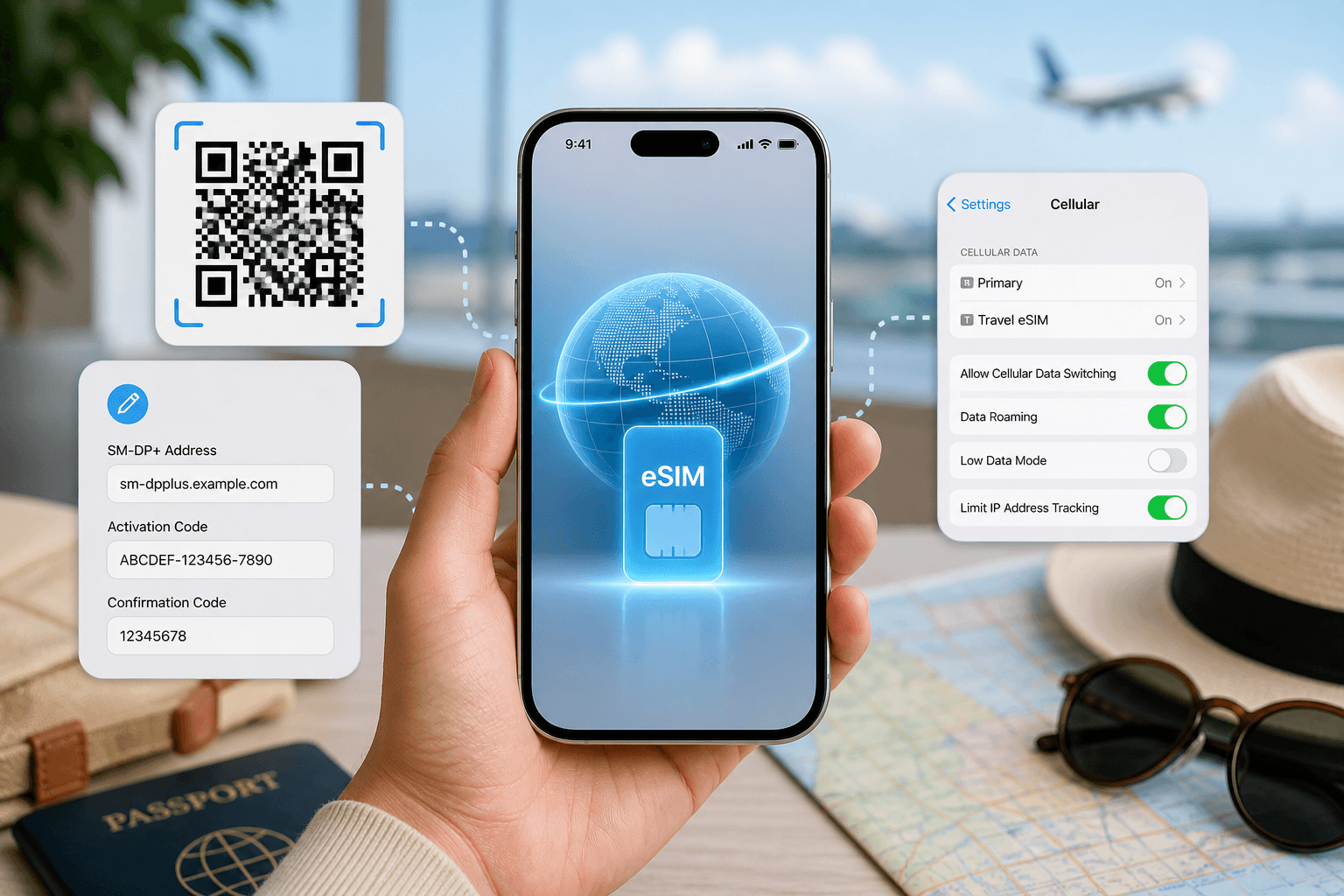
You can buy through the BeeSim app or website, then install by QR code or by manual SM-DP+ entry. Install before you leave if you want; validity starts at the first connection in the destination, not at installation.
Use these paths to avoid turning on the wrong line:
| Phone | Install path | Set mobile data line | Turn on roaming for the eSIM |
|---|---|---|---|
| iPhone on iOS 17/18 | Settings > Cellular or Mobile Service > Add eSIM > Use QR Code | Settings > Cellular or Mobile Service > Cellular Data | Settings > Cellular or Mobile Service > tap the eSIM line > Data Roaming |
| Samsung on Android 14/15 | Settings > Connections > SIM manager > Add eSIM > Scan QR code | Settings > Connections > SIM manager > Mobile data | Settings > Connections > Mobile networks > Data roaming |
| Pixel on Android 14/15 | Settings > Network & internet > SIMs > Add SIM > Set up an eSIM | Settings > Network & internet > SIMs > Mobile data | Settings > Network & internet > SIMs > tap the eSIM > Roaming |
| Xiaomi on Android 14/15 | Settings > SIM cards & mobile networks > Manage eSIM > Add eSIM | Settings > SIM cards & mobile networks > Default for mobile data | Settings > SIM cards & mobile networks > tap the eSIM > Data roaming |
Keep your home SIM available for calls if you need it, but set mobile data to the travel eSIM. If the phone asks which line should use mobile data, choose the travel eSIM line.
What can go wrong with the cheaper option?
The cheapest-looking option can fail if it does not match the trip pattern. Fix the common problems before you buy, not after the plan is half used.
- You undercount video. A single 1-hour Zoom or Teams meeting can use 0.8-1.5 GB. Add meetings separately instead of hiding them inside “normal” use.
- You forget cloud backup. Photo backup at 3-5 MB per photo can turn a sightseeing day into a heavy data day. Turn off mobile-data backup before arrival.
- You choose a plan that expires early. Check both GB and days. A 50 GB plan is not useful if its validity is shorter than your stay.
- You assume hotspot is always included. Check tethering on the individual plan page. A 30-minute email-and-web hotspot session is about 100-300 MB even before video.
- You expect to top up later. Plans cannot be topped up; if you run out, buy another plan.
- You compare against roaming without checking the real roaming terms. Do not use a headline roaming promise as your break-even. Compare the exact roaming allowance and restrictions from your mobile provider with the live eSIM plan page.
- You install correctly but get no data on arrival. Check that the eSIM line is selected for mobile data, data roaming is on for that line, airplane mode is off, and the phone has connected in the destination. If it still does not work, contact support by email from the site.
For payment and refund rules, use the current help page at /faq rather than an old article or screenshot.
How do you make the final choice in five minutes?
Open the destination page, then do the calculation in this order:
- Pick light, normal or heavy use.
- Multiply by your trip days.
- Remove any fixed plan whose validity is too short.
- Remove any fixed plan whose GB total is below your estimate, unless you are willing to buy another plan later.
- Divide each remaining fixed plan’s live cost by its GB allowance to find value per GB.
- Compare the surviving fixed option with the daily plan for the same destination and trip length.
- Buy the option that covers your expected data and validity with the lower live cost.
If your result is close, choose based on risk: fixed GB for predictable use, daily high-speed allowance for uneven days with video, uploads or tethering.
More destinations
All destinations →Topics
Frequently asked questions
Does a travel eSIM give me a local phone number?
BeeSim plans are data-only, so they do not include a local phone number or SMS. Use messenger apps for calls and messages if you need them.
Can I install the eSIM before I travel?
Yes. You can install it at home, and the plan validity starts at the first connection in the destination.
What happens if I run out of data on a fixed plan?
Plans cannot be topped up. Buy another plan for the same destination or a suitable regional bundle if your trip continues.
Should I use the app or the website to buy?
Either works. Use the BeeSim app if you prefer managing the eSIM on your phone, or the website if you are comparing several destination pages on a larger screen.
Where do I check payment and refund details?
Use the current help page at [/faq](/faq). It is better than relying on an article because those rules can change.
Editorial Team
Guides and articles from our editorial team.
Related articles
- BeeSim vs Nomad
BeeSim vs Nomad: which travel eSIM to pick for 7 destinations
BeeSim vs Nomad across 7 destinations: plan sizes, unlimited rules, hotspot, top-ups, refunds and what to check before buying.
Oct 18, 202611 min read
- iPhone eSIM
How to install a travel eSIM on iPhone: QR code, manual SM-DP+ entry, and the settings people miss
Install a travel eSIM on iPhone with QR or manual SM-DP+ entry, then set the travel line for data and turn roaming on when you arrive.
Oct 15, 20269 min read
- eSIM
What an eSIM Is and How to Use It for Travel
A simple guide to travel eSIM basics, phone checks, buying, installation, and what to switch on after landing.
Oct 14, 20263 min read3 views
- eSIM comparison
BeeSim vs Saily: 7 destinations, hotspot and refunds
Compare BeeSim and Saily across 7 destinations, with plan sizes, unlimited limits, hotspot rules, top-ups and refund checkpoints before you buy.
Oct 14, 20269 min read
- cruise eSIM
eSIM on Cruise Ship: What Works at Sea and in Port
Cruise data guide for sea days, port calls and tender boats: when a travel eSIM works, which plans fit, and what to check before sailing.
Oct 11, 202610 min read
- eSIM compatibility
Does my phone support eSIM? iPhone, Samsung, Pixel and Xiaomi checks
Check whether your iPhone or Android supports eSIM, confirm it is not carrier-locked, and find the exact settings path before installing a travel plan.
Oct 3, 20269 min read3 views